
The Axon
Google Search of SETI Net
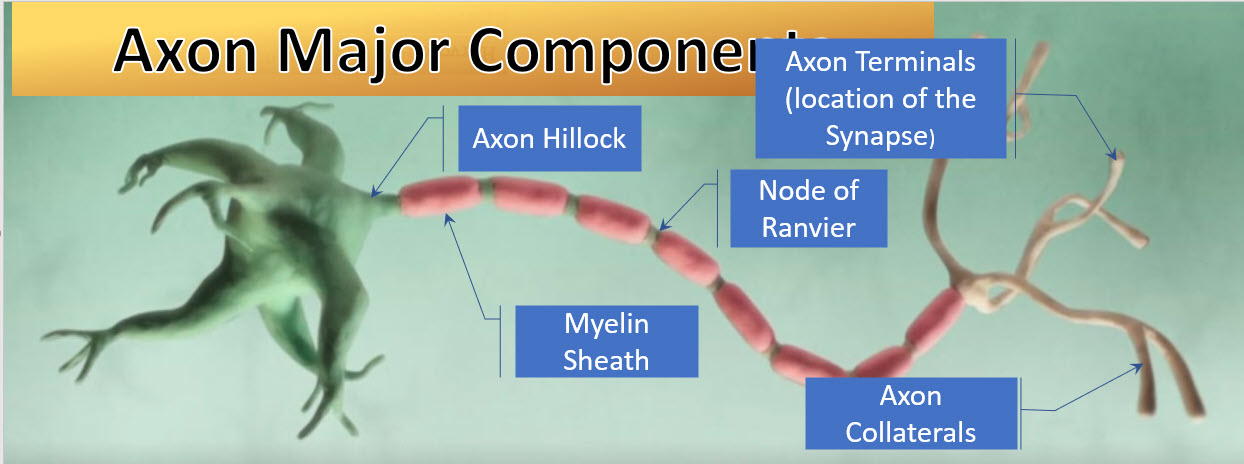
The Axon is a structure that is found only in neurons. It is highly specialized for the transfer of information over long distances in the nervous system. The Axon begins with a region called the Axon Hillock in the Soma body and tapers to form the initial segment of the Axon.
Axons may extend from less than a millimeter to well over a meter and often branch. These branches are called axon collaterals. Occasionally, an axon collateral will return to communicate with the same cell that gave rise to the Axon. This type of axon branches is called a 'recurrent collateral.'
Question: Can more than one Soma connect to an axon?
Biological Norm: One Soma → One Axon
In virtually all neurons:
-
Each soma (cell body) gives rise to its own axon.
-
The axon is the output cable of that individual neuron.
-
Axons can branch (via collaterals), but all branches still originate from one soma.
Propagation Delay Through Axon's
Propagation delay through an axon can be estimated using the conduction velocity of the action potential and the length of the axon.
Basic Formula

Parameters
-
Axon Length (L): in meters (m)
-
Conduction Velocity (v): in meters per second (m/s)
- Propagation Delay (Δt): in seconds (s)
Axon Length
| Neuron Type | Axon Length |
|---|---|
| Short Interneuron | < 1 mm (eg in the cortex} |
| Cortical Projection | few mm to few cm |
| spinal motor | up to 1 meter (humans) |
| Sensory (e.g. toe to spine) | over 1 meter |
| Autonomic | few mm to tens of cm |
The tip of each Axon Collateral is where the synapses are formed. Synapse operation is covered extensively in standard textbooks and classes but are not part of the NeuronLab simulator except as described in 4. Synapse .
Glia cells (not shown) provide layers of membrane that insulate axons. This wrapping, called myelin, spirals around axons and provide insulation to the Action Potential that travels down the Axon.

The myelin sheath does not extend continuously along the entire length of the axon. There are breaks in the insulation where ions cross the membrane to regenerate action potentials. The breaks in the myelin sheath are called the Nodes of Ranvier and act as relay points for the action potential as it moves down the axon chain. Voltage-gated sodium channels are concentrated in the membrane of these nodes.
In the human femoral nerve the primary sensory axon is approximately 0.5 m long and the internodal distance is 1 to 1.5 mm; thus approximately 300 to 500 nodes of Ranvier occur along a primary afferent fiber between the thigh muscle and the cell body in the dorsal root ganglion. [Kandel page 152 *]
The distance between nodes of Ranvier is usually 0.2–2.0 mm, depending on the axon size (fatter axons have larger inter-nodal distances).
Conduction Velocity
The myelination thickness affects the conduction velocity of the axon. The following table is a guideline[Kandel page 412 *]
| Diameter (MM) | Conduction Velocity (M/Sec | Notes | |
|---|---|---|---|
| Smallest | 0.2-1.5 |
0.4-2.0 |
Unmyelinated |
| Small | 1-6 |
4-36 |
|
| Medium | 6-12 |
36-72 |
|
| Large | 12-20 |
72-120 |
Larger axon diameters allow for faster conduction speeds, especially when combined with myelination.
Distance between Nodes of Ranvier (internodal Length)
- Range 200 uM to 2,000 uM (up to 2.5 mm in humans)
- On average, larger axons have longer internodal distances.